
On Friday, Biden announced his intent to appoint 14 people to the advisory committee, which provides overall policy advice to the United States trade representative on matters of development, implementation, and administration of the US trade policy.
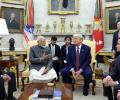
'By his words, actions, and body language during their joint press appearance wanted to convey his personal respect and, more broadly, his desire to work closely with India.'

'Alongside economic growth and the Asian century, stress has become an Asian caravan.' 'But stress doesn't arrive in one's country as invitation to taste exhaustion. It comes dressed as a challenge.' 'Its evangelists ask: Are you man enough to shoulder stress?' points out Shyam G Menon.

'We have to keep a watch because India-Sri Lanka has a history that whenever there has been a change in government, either the connectivity projects have been questioned or cancelled or revived.'

'The border deal offers a hedge for India against Trump's unpredictability when it comes to his approach to competition with China.'

'The assessment of most people is that there is a stable economic and political environment in India and that is attractive to investors.'
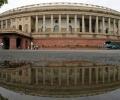
A reformed Planning Commission should reflect the diversity of Indian debate.

Ahead of the upcoming elections, political parties have started announcing incentives to benefit women, but what do women truly seek for genuine gender parity, asks Nivedita Mookerji.

This is the full text of the address to the nation by President Droupadi Murmu on the eve of India's 78th Independence Day.

'Trump's disregard for norms and institutions could prove very costly for America's social fabric.'

Moody's Ratings on Tuesday said India's growing water shortage can disrupt farm and industry sectors and is detrimental to the credit health of the sovereign as rising food inflation and decline in income may spark social unrest. It said decreases in water supply can disrupt agricultural production and industrial operations, resulting in inflation in food prices and hence can be detrimental to credit health of sectors that heavily consume water, such as coal power generators and steel-makers.

'With India's growing capabilities in the space sector, this creates promising opportunities for enhanced collaboration and market access.'

The Tata Group is one of the very few Indian MNCs which has carved out a niche in China's highly competitive market, notes Rup Narayan Das.
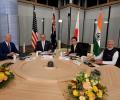
Saturday's Quad meeting in Delaware is taking place against the backdrop of China's assertive behaviour in the South China Sea, its sabre-rattling in the Taiwan Strait and increasing footprints in the Pacific and Indian Ocean, asserts Rup Narayan Das.

Prime Minister Narendra Modi has said that India's economic growth is a 'natural by-product' of his nine-year-old government's political stability, as he expressed optimism that it will be a developed nation by 2047 with 'corruption, casteism and communalism' having no place in our national life.

India scripted history as the ambitious third Moon mission of the Indian Space Research Organisation (ISRO) touched down on the Moon's south pole, propelling the country to an exclusive club of four and making it the first nation to land on the uncharted surface.
'Narasimha Rao asked me why China was doing so well in attracting foreign investments and I gave my frank opinion.' 'I told him that giving thrust to exports had to be a national effort.' 'But in India, the system was very centralised in the Government of India and the state governments had no role to play.'

RBI Governor Shaktikanta Das and Finance Secretary Subhash Chandra Garg are also expected to attend the meetings.

'it's not just youth in India who are left behind because of their inability to find jobs; nearly two-thirds of Indian women of working ages do not participate at all in the paid labour force.'

Opportunity for India to take leadership in economic diplomacy.

It is in circumstances like this that the Constitution becomes extremely important. It reminds us that we have a commitment towards higher human values to fulfil, a path to get back to, suggests Shyam G Menon.Else, we risk being rudderless in an ocean of money and majoritarianism, suggests Shyam G Menon.
Most forecasts do not have a track record of transparency and accuracy

The Chinese had enough foreign reserves.

Six decades and more later, we are now captives of our identities. Every poll is based on elaborate calculations of electability of candidates on the basis of their castes and other narrow definers. That, along with voter promiscuity, is what defines our political culture, which remains stubbornly resistant to any change, asserts Shreekant Sambrani.

The fundamental construct of India's neighbourhood policy still needs to be what Vajpayee postulated, Manmohan Singh embraced, and Modi energised. It's just that we need to junk domestic politics and excessive religiosity, while acquiring much humility and a renewed respectfulness towards our neighbours, recommends Shekhar Gupta.
'We should not underestimate the power of Hindutva.'
The Bengal outcome can have a marginal impact on national politics. Whereas elections in UP next year might still change the course ahead of the parliamentary poll in 2024, observes Virendra Kapoor.

There were certainly qualities adhering to the Tata Group, which emanated from the persona of Ratan Tata. Most notable of these would be the low profile he maintained, which sharply contrasted the in-your-face celebrity status, celebration of wealth and pursuit of importance many of liberalised India's rich, love, notes Shyam G Menon.

Noting that India has 'limitless possibilities and countless opportunities', Modi urged the BRICS business leaders to take advantage of them.

'In India those who want change cannot bring about change, and those who can bring about change do not want change.'

Times have changed, situations have changed, but the basic nature of superpower geo-politics remains the same and so also India's diplomacy -- call it non-alignment, strategic autonomy or neutrality; it all depends on the time scale, notes Rup Narayan Das.

One hopes in his next term, Narendra Modi will take up the mission of inculcating respect for following rules in Indians as a mission. Therein lies the chance for India to become a developed country, asserts Colonel Anil A Athale (retd).

Time magazine lists 100 'people who inspire us, entertain us, challenge us and change our world'.

'Even though as Xi will seemingly continue to stay in power beyond his third term, competitions for the post-Xi leadership would be inevitably unfolded beneath the surface of water, and that will be a big headache for Xi the dictator.'
A group of faculty members of Ashoka University has written to its vice chancellor claiming that free thought within universities in India is in crisis today and demanded that all decisions on matters related to academic freedom should be put on hold till the promised committee for academic freedom is in place.

'Make in India' could suffer the same fate as did privatisation and the command economy, says Ajit Balakrishnan.

'If such a practice were feasible, every state would seek additional funds, posing a significant risk to the overall health of the economy.'

When I was leaving Pakistan and going abroad I had no feeling of happiness but today I am happy, Sharif said.

Bangladeshis are unwilling to give up peace and growing incomes for the chaos witnessed during the BNP-led four-party alliance rule, says Anand Kumar.
'India finds itself in an unenviable situation today with its prospects diminished by acutely polarised domestic politics and the setbacks suffered during the pandemic,' notes Ambassador Shyam Saran, the former foreign secretary.
